Translate

Sunday, November 1, 2015

STEVE JOBS 11/1/15


Watching the STEVE JOBS  biopic directed by Danny Boyle and written by Aaron Sorkin was a nostalgic experience, bringing me back in time to 1992 when I purchased my first Apple Computer which regretfully turned out to be a “rotten apple with so many problems that Apple’s headquarters sent a technician to my home in NJ to change the “motherboard.” This was the “dark phase” of  the company when it was on the downswing - the percentage of Apple users were declining and IBM’s P.C.’s were on the rise.  Because my “mentor” was a rabid supporter - never wavering in his belief in Steve Jobs and Apple products, I too followed his lead despite the fact that Jobs was not with the company having been “fired” in 1985. The film STEVE JOBS gives us a glimpse into the man who today is considered a visionary having changed the way we communicate and navigate the world.

I once wrote a Letter to the NY Times extolling the power of film “… to re-vise, re-invent and re-position history and historical figures within popular culture… Too often ideas, whether they be political or cultural, permeate into the general consciousness through the membrane of a director…”  And this holds true for director Danny Boyle’s depiction of Steve Jobs. There is a frenetic pace to the film - and  Boyle uses the moments before the  presentation of new products to an audience of devotees as a vehicle “exposing” the complexity of Steve Jobs’ personal and professional history. 

The  dramatic focus of the movie STEVE JOBS  hinges upon 3 major “computer launch” events - the original Macintosh in 1984 in competition with the Apple II - the commercial bedrock of the company; the unveiling of NeXT cube in 1988 - what it did is still a mystery; and the beautifully designed iMac in 1998 - the start of the “iEra”.  The products were an extension of the man himself - a person who controlled every aspect of his brand - obsessively committed and singleminded - never one to compromise - as witnessed by his battles with childhood friend and co-founder Steve Wozniak - Seth Rogan doing a great job as this decent, burly “nuts and bolts” man who actualizes Jobs’ idealistic concepts. Michael Fassbender is excellent as Jobs - cool, detached  and charismatic  encased in armor that is rarely penetrated except by the always-by-his side assistant Joanna Hoffman (a staid and respectful Kate Winslet with a weird  undertone of an accent) and his daughter Lisa, (whose paternity he once renounced,) - a pivotal character functioning as a catalyst and humanizing foil to the self-absorbed and fervid Jobs.

There is a claustrophobic feel to the film - an undercurrent of acute tension created by Job’s contentious and  truculent interactions with his colleagues and family; the need to micro-manage every one of life’s moments leaving no room for respite - we the audience suffer from the lack of air. I also left the theater wondering WHAT exactly did Jobs do as co-founder of Apple Inc.outside of being a genius marketing promoter? 


 I recommend reading Walter Isaacson’s authorized biography of Steve Jobs, particularly after seeing a movie which gives you a narrow, surface view of an impassioned man who deserves to be seen more fully  to understand his historical importance as that rare individual whose accomplishments touched people all over the globe. Regrettably STEVE JOBS gives very little inkling of the man who  anticipated much of the 21st century’s technological innovations.

Monday, October 19, 2015

MANA CONTEMPORARY and INTIMACY IN DISCOURSE: REASONABLE SIZED PAINTINGS 10/18/15

Went out to  Jersey City, NJ to MANA contemporary  which is becoming a MALL of art studios and exhibitions. A lot of the art I saw was mediocre as were the rash of shows. I was very disappointed by Saul Ostrow's curated "Here's Looking Back at you: Images of Woman from the ESKFF Collection." There are big names with small works and lesser known artists whose works were larger and cuddling up to cheap gimmickry highlighting bravado brushwork signifying nothing. Tour-de-force photo-realistic paintings that were a shallow display of technique- all surface and nothing to plunge into.

The best exhibition by far was curated by Phong Bui titled INTIMACY IN DISCOURSE: REASONABLE SIZED PAINTINGS. Each of the artists showed a series of works - all beautifully curated - chosen with intelligence and hung with an awareness of how they played off against one another. There are varieties of paint surfaces and styles from aluminum to burlap; abstraction to figuration and a few that were a combination of both. I was immediately attracted to the 4 simple, lovely paintings of trees silhouetted against the sky by Sylvia Plimack Mangold - her brushwork was so fluid that I was thrilled. Minimalism meets figuration with a loving hand.

A wonderful mini, mini retrospective of works by Bill Jensen- ranging from the 1970's to 2013 and a good choice of terrific paintings by Thomas Noskowski. I also responded to Robert Storr whose small strangely colored paintings - had lost some of the awkwardness that I remembered and actually loved; but though more confident there is a still a quirky color palette that threw me off balance. Rackstraw Downs showed images from his Barbed Wire series and one slightly larger more panoramic view. I am less and less of a fan of his work - feeling that the colors and brushwork are in a tradition in which he is perhaps too comfortable - despite being successful.

James Siena had some beautifully painted meticulous op-art-y works that lit up the room as did Ann Pibal and Tom Burckhardt. Robert Feintuch's weird and often grotesque figurative paintings had me return to look at them again and again because they felt so compelling in their distorted beauty. Ellen Altfest's image of a leg - an abstracted form cut off floating in the center of the canvas - combined the sensuous with the mysterious - a small work that makes me want to see many more. This is just a taste of what is available to see and worth the trip to 888 Newark Ave, Jersey City, NJ 07306.
http://www.manacontemporary.com/2015-intimacy-in-discourse/
A raw, unedited video is available on youtube at:
http://tinyurl.com/nnf9vx4


Saturday, October 17, 2015

BRIDGE OF SPIES 10/17/15


Director Steven Spielberg is the conscience of American film-makers, delving into the dark places of our history - the morally shaky ground of policymaking in a country that prides itself on its belief in upholding the principles of the U.S.Constitution. In his latest film, BRIDGE OF SPIES, he pokes a stick into the headlines of Cold War events - the 1960 U-2 Spy plane incident, in order to shed air and light into the shadowy reaches of official myth-making. Aware that this can be done most powerfully through precise direction, detailed sets, soaring soundtracks, and cinematography that echoes the dreary mood of the times - bright sunshine recedes behind the shadows of deception. The audience is always entertained, despite the subject matter’s depiction of  the  murkiness of ethics and morality. Like the great illustrator Norman Rockwell - we are seduced by an “apple pie” ethos, except there are worms wriggling around in the crust.

Tom Hanks is perfectly cast - an actor who I cannot remember ever playing a “bad” guy - as James Donovan, an insurance lawyer conscripted by the CIA in 1957 during the height of the Cold War hysteria to defend the arrested Soviet mole, Rudolf Abel, (an academy award winning performance by Mark Rylance,) and participate in a US government programmed “kangaroo-court” trial. Except James Donovan believes in the right of an individual to the best defense as the bedrock of our democracy, not willing to compromise his deeply held integrity.

BRIDGE OF SPIES begins with a panning of a dreary Brooklyn street with the Manhattan Bridge in the background looming over the landscape, the camera eventually lands upstairs in a tenement building where Mark Rylance/Rudolf Abel is looking at himself in a mirror painting a quite good traditional self-portrait. This double view is our introduction to the personality of a seemingly Walter Mitty-like individual, his physiognomy imprinted with a haunting and magnetic expressiveness, conveying adversity and conviction. Rylance's sympathetic portrayal of Abel is seductive and thrilling; this spy is a mystery and remains so.

Tom Hanks/James Donovan - a  reincarnation of Jimmy Stewart (thicker in physique) lives a 1950’s  dream life in suburbia; three children and a clueless stay-at-home wife and mother (played by Amy Ryan in a thankless part.) Women are just accessories in this movie - indicative of how they were considered at the time. Thank goodness for the Feminist Movement 20 years later! Getting involved with cloak and dagger politics does not change Donovan - he is incorruptible and strongly rooted to the ideals of American values as put forth in the Constitution and Bill of Rights.

At the same time as the Abel trial - America is preparing to send a U-2 spy plane equipped with surveillance equipment over Soviet territory and the Central Intelligence Agency recruits a young pilot Francis Gary Powers (a bland, handsome Austin Stowell) to complete the reconnaissance mission. In 1960, the operation is implemented and shortly thereafter the U-2 spy plane is shot down by a Soviet surface-to-air missile and Powers parachutes unto Russian soil still alive and is captured and sentenced to a long term of imprisonment and hard labor. A politically heated issue and an embarrassment for the Eisenhower administration - the incident was vigorously denied by the USA and a cover-up was attempted, but the covert military maneuver was ultimately exposed.

Attempts are made to return Gary Francis Power to the USA in order to interrogate him about how much classified information he revealed to the Soviets. The authorities turn again to Attorney James Donovan to negotiate the exchange of spies on Glienicker Bridge in East Germany - Rudolf Abel for Gary Francis Powers; the tension and drama of BRIDGE OF SPIES begins against the backdrop of the Wall being erected in East Berlin - a bleak city in contrast to its counterpart in the Western sector.


 Pragmatic political behavior by officials in the KGB, CIA and FBI are all stick figures in the chess game of diplomacy and Tom Hanks deftly navigates his way through the labyrinth of innuendo and deceit. Espionage, duplicity, betrayal are at the heart of this film. What makes it palatable is the humanity of both Tom Hanks and Mark Rylance’s characters who bond with mutual respect, despite their opposing ideological viewpoints. Director Spielberg can be sentimental, but is able to tunnel through the sappiness with humor and affection. He really likes his two leading men and so do we.

Tuesday, October 13, 2015

THE MARTIAN 10/13/15


I am fascinated by films that show how people survive in impossible situations. THE MARTIAN  is an old- fashioned “feel good” movie directed by Ridley Scott who knows how to make blockbusters and hold your attention - though here he goes “off course” from his usual dystopian science fiction-y horror movies like his breakthrough thriller “Alien.”

THE MARTIAN is basically about Mark Watney, (a breeze-through performance by Matt Damon,) as an affable brilliant, but down-to-earth botanist/scientist on a manned flight mission to Mars who  is left stranded on the “red planet",  after a fierce storm untethers him from the rest of the crew. Dramatic footage of sand and flying debris slamming the spaceship upending its stability, forces Jessica Chastain (performing in a minor role as Melissa Lewis, the flight Commander) to make the agonizing  decision to abandon their fellow crew member - assuming he was killed by some space junk that pierced his body -  to continue their NASA mission.

The quiet after the storm shows us a steadfast Matt Damon awakening to his dire predicament, and the knowledge that death is almost a certainty, but never panics; rather he is optimistic, immediately going into survivalist mode - step by step using all that science and life experience has taught him in order to figure out how to live on a planet without water or food. One advantage is the artificial space vehicle/living habitat, or Hab which is still intact - providing oxygen and dietary supplies including his fellow astronauts’ personal effects, along with a trove of "bad" music that becomes an ongoing joke in the film. The lighthearted likeability of Matt Damon, who relates his daily chores and mundane skirmishes with the airless “elements” via a video diary - a technique that keeps the film buoyantly hopeful; psychological depression never sets in - so we know that Hollywood has cast a rosy net of oblivion around THE MARTIAN. And by doing so, it feeds directly into the hearts of Rocky Balboa, and sports viewing fans - we love to see America’s can-do spirit triumph.

This is intrinsically a story about man’s ability to endure in the face of terrible odds - which makes for great theater, and we in the audience cheer him on. Who cannot get caught up in this existential dilemma and not feel the intensity of Mark Watney’s battle to exist? He is not alone - eventually there are others who join the fight to aid him in his heroic efforts to stay alive in an “alien” atmosphere; everyone realizing that there is a looming deadline when necessities will be depleted. Lots of actors contribute to the ensuing drama and add to the film’s tension, which involves the diminished "window of opportunity" - to bring Astronaut Watney home while he is still alive, as the months glide by. 


The supporting actors were chosen to exemplify a “type” in the movie: Jeffrey Daniels as NASA’s Director, caught in the vise of the political ramifications of his decisions; Michael Pena, a fellow space traveler who is the jesting buddy; Chiwetel Ejiofor, an assistant at NASA who is a catalyst for getting things done; and  a surprisingly wonderful scene-stealing performance by Donald Glover as a young “idiosyncratic” Jet Propulsion Lab scientist whose mathematical computations lead to innovative approaches in the rescue attempt to bring Watney home. Being a bit of a wonk, even though I don’t understand the mathematics and physics involved in the computations, I am thrilled seeing numbers and formulas no longer sitting abstractly on notebook papers, but put to use to change the world we live in- another example of what a group’s inventiveness and a resilient outlook can accomplish.

Saturday, October 3, 2015

SICARIO 10/3/15


What are the rules of engagement in fighting the Mexican drug cartels especially if US law enforcement agencies go into foreign territories where they have no jurisdiction; does the end justify any means? Denis Villeneuve’s intense new film SICARIO (which means hit man in Spanish) takes us into the tactical underbelly of those cryptic individuals who carry out US policy decisions “from on high”,  cloaked in legitimacy, though they are prohibited maneuvers that would be considered illegal in any court of law.

The atmosphere is beautifully filmed - either pale, washed out ochers depicting the long dusty border between US and Mexico, or the rich deep blues and blacks of the evening with night - vision goggles irradiating the world around them into skeletal images. Put a young, female FBI agent into this mix - Emily Blunt as Kate, a dedicated officer, former head of a kidnap-response unit based in Phoenix, who is forced to question all that she has practiced and been taught in the Bureau; her fiercely held personal values are turned upside down by the reality of being recruited into the midst of anti- cartel “warriors” who can behave as dark and dirty as their enemy - the drug lords that  control the populous by murdering and slaughtering men, women and children, stringing up body parts hanging them from electricity wires like abandoned baggage on clothes-lines.

Transporting, manufacturing,  shipping and controlling the wildly lucrative  drug industry necessitates making alliances - everyone is  corruptible from the dealers to the federales  and police on both sides of the border - all partaking of the spoils, while their interior sentiments become ghosts evaporating into the surroundings. “It is not personal” are words that exemplify the cool calculations of those in power whose humanity has been shredded, and who barricade themselves with bodyguards and fancy homes from the brutality that they inflict on nameless people.

Kate and her FBI partner ( a good performance by Daniel Kaluuya) are the two newcomers brought along on a mission that they were not briefed on - so the “fog of war” is indeed literally murky. Everything becomes clear with time, but meanwhile we in the audience are as mystified as the protagonists. We meet a team of hardened DEA operatives with Josh  Brolin as Matt - the wise-cracking, gum chewing leader who is a cipher, offhandedly refusing to respond with a straight answer to any question put before him. Despite his Cheshire-like grin, there is a man beneath the lumbering, impenetrable veneer who is callously determined to fulfill the U.S. government’s calculated goals no matter the toll.

Benicio Del Toro is the “star” of SICARO, brilliant as the mercenary Alejandro - a person whose face reveals little, but whose eyes and body language betray a passionate resolve for revenge, and a history of incomparable  pain and suffering at the hands of the drug-lords becoming a person for hire with no longer a “soul” to lose. He is the “enforcer,” expert at torture and killing, yet despite his horrific activities, every moment he is on the screen it is filled with his abundant presence and an acute sense of heartache. 


Kate’s sojourn from an idealistic FBI agent to an awareness of the brutal realities of the contaminated policies used by the United States to combat the  “drug war” is a bit naive and inconclusive. We sense that she remains a staunch believer in the underlying principle of the “rule of law”, but we know all-too-well that she is standing on shaky grounds.

Saturday, September 26, 2015

POWER PROTEST AND RESISTANCE - THE ART OF REVOLUTION 9/26/15


Danny Simmons and Oshun Layne are the curators of this ambitious show, with over 100 participating artists being exhibited in 3 venues - RUSH GALLERY Gallery, Chelsea, NYC; SKYLIGHT Gallery - Bed Stuy Restoration Corp.Brooklyn,  and SALENA Gallery on the LIU Brooklyn Campus. Since I am exhibiting in RUSH ARTS my focus is on that particular space, but I encourage everyone to go to all three. POWER PROTEST AND RESISTANCE comes straight outta the blaring tabloid headlines; many of the works address the anger of those who feel powerless in the fight against institutionalized control which is considered by many to be an entitlement - not to be examined or investigated. But there is a “tipping point” where a tsunami of voices can crash into the structures of government and demand to be heard - no longer guarded and blazing internally with rage in the face of the tactics of intimidation and fear.

Upon entering the gallery, the tone of the exhibition is set with Paul Deo’s black and white painting  of a disembodied head screaming BE HEARD quoting Martin Luther King: “There comes a time when silence is betrayal”; underscored by the artist Tafa’s futuristic abstract painting, PROTEST/MARCH-DOUBLE SYNTHESIS railing against a democracy that “incarcerates millions of its youth” implicating not only the brutality of the system but the silence of the majority. 


There is an immediacy and intelligence to many of the artworks; some are very direct - such as Kristine Mays’ wire hoodie, as beautifully delicate as lattice but referencing chain-link fencing to guard against the exposed tenderness of the flesh. On the other hand,  Shellyne Rodriguez creates a whimsical looking chandelier in the shape of an eye, made up of mousetraps titled THE PROTOTYPE FOR BELPHEGOR’S EYE.  Belphegor, a recurring character in her work “is the demon of SLOTH who imbues its prey with spiritual or emotional apathy…” Rodriguez is incriminating all those who exploit their brethren for their own predatory greed, trapping them through the temptation of wealth and meaningless displays of ostentation. 


Cey Adams touching 12”x12” silkscreen and enamel on canvas paintings titled “”4 Little Girls” references the1963 murders of  the young African American girls - Addie Mae Collins, Denise McNair, Carole Robertson and Cynthia Wesley - in the basement of the 16th Street Baptist Church in Birmingham Alabama. The faces in the works are almost invisible and as you move around and look closely attempting to grasp their appearances, we perceive ghostly images emanating in and out of the canvas referencing the chimerical function of memory - fleetingly out of sight but permanently etched into the weave of history.


Sol’Sax’s digital photograph THE BLACK POWER MOJO HEAD also invokes a seminal point in the fight for human rights, when Tommie Smith and John Carlos, both shoeless wearing black socks  to echo poverty raised their gloved fists, heads lowered, in the gesture of the black power salute during the playing of The Star Spangled Banner at the 1968 Olympics medal ceremony. In his statement accompanying the photograph, Sol Sax wrote: “I anchor Tommie Smith and Joh Carlos’s historic Olympic protest pose in Congo ancestral magic…Racism, Europeans magic means of supremacy is confronted with The Congo Nkisi Nkondi that means ancestral knowledge or spirit from heaven that hunts in this case the inequities of a racist society. By placing Minkisi Minkondi (the plural of Nkisi Nkondi) in the context of the black power movement I seek to point to the ancestral roots of this magical protest pose…”  


Che Baraka’s work, AN ANONYMOUS PAIRING, astutely shows the roots of cubism in African art by altering Picasso’ SEATED NUDE AND STANDING NUDE revealing that the beginnings of modernism is based on cultural imperialism without attribution to its sources. Baraka wrote “…that the piece also addresses the inherent value of brown bodies and suggests an interplay of different strategies for social re-envisioning as symbolized by the Elegba and Guy Fawkes masks.”


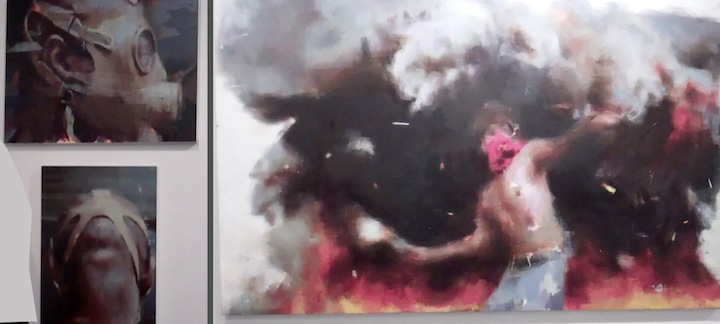
Jerome Lagarrigue painted a triptych- BATTLE FOR AREA X and GAS#2 and BACK OF A PROTESTER’S HEAD - that graphically portrays the universal gestures of violent protest occurring  all over the globe depicting heaving bottles, molotov cocktails, throwing of stones, etc. against rulers who have access to tanks and tear gas to squelch dissent. Other artists address domestic issues - familiar staples of recent news media - that slip in and out of our consciousness - names change, soon to be forgotten, but the iconic images of art contradict this burial of awareness. Taha Clayton’s SATURN paints a portrait of Kalief Browder who at age 16 was wrongly arrested and sent to Riker’s Island Correctional Facility for 3 years for stealing a backpack - 2 of those years spent in solitary confinement. He was eventually released and shortly thereafter killed himself. Clayton shows Browder, eyes shut, flying into the vastness  of the atmosphere, enveloped in peace. He includes a quote from Stevie Wonder’ s lyrics to Saturn.


In her mixed media piece, FOR TITO (IN HOMAGE TO SANDRA BLAND,) part of a series exploring issues of police brutality, Sophia Dawson did not forget Sandra Bland whose questionable suicide days after being stopped for a supposed traffic infraction, landed her in jail for questioning the arresting Officer’s authority. Watching the  incident on video reaffirmed the deplorable complacency of authority placed in the hands of people whose beings are often permeated with ignorance  and contempt. And then we have a painting by Jas Knight titled RAY’S GAZE of former officer Ray Tensing who shot an unarmed Cincinnati motorist, Samuel DuBose in the head, after being stopped for not having a front license plate on his automobile. Jas Knight wanted to show the face of hatred and incise it into our cognizance letting the world know that the perpetrators of malevolent actions are going to be remembered.


Regrettably I have only written about a few of the pieces that are up in these provocative exhibitions, I urge you to attend all three venues.

Saturday, September 12, 2015

LEARNING TO DRIVE 9/12/15


I do not like to drive; actually I am scared of driving. My father used to say being behind the wheel of a car meant that you had one foot in the grave (or was it  jail?) and the other in heaven. Those words still resonate with me loud and clear - the aberrant background of my fears. On the other hand, I love to be driven around and rely on the “kindness” of friends. My greatest wish would be to have a chauffeur at my beck and call - ahhh that would be divine!  So the title of director Isabel Coixet’s new lightweight comedy brought me into the theater to see LEARNING TO DRIVE

I like Patricia Clarkson (Wendy), the heroine, an accomplished literary critic whose husband, a flat emotionless Jake Weber playing Ted the unsatisfied and straying husband, walks out on Wendy and their daughter Tasha (Grace Gummer) to again fulfill his dreams/libido. LEARNING TO DRIVE becomes a metaphor for becoming self-sufficient and not needing jerks to be part of your life. Of course there is a catalyst, the wise, calm, driving instructor/life tutor, Darwan (an always wonderful Ben Kingsley) to lead her on the path to liberation; a pretty straight-forward predictable romantic tale with some detours and insights tossed into the mundane mix. 

We do get to see the social inequities in life-styles between the upper class, brownstone dwelling Wendy, and Darwan, a Sikh, who lives with three other landsman in one room, sharing the little space they have with camaraderie and resignation. Darwan had been a Professor in India, but was forced to flee, receiving political asylum and becoming an American citizen, earning a living as a cabbie and driving instructor.

I was dismayed to see Patricia Clarkson in an impassioned, frenzied moment, begging her errant husband to return to the hearth. I did my usual audible moaning and groaning in the theater - not having the heart to watch these appalling scenes of desperation. I restrained myself from shouting - It will get better, girl - it will! 
And it does! Meanwhile Darwan’s sister in India arranges for him to marry a middle aged woman Jasleen (a lovely Sarita Choudhury,) self-conscious and unsure of herself, having no knowledge of English, who travels to the United States, where we witness the adjustments both she and Darwan need to make in order to fuse their mutual loneliness into an affectionate, respectful relationship.


I did get a few driving tips - my goal in seeing LEARNING TO DRIVE - but none as great as the crime fiction novelist Elmore Leonard’s recommendation to never come to a stop too close to the car in front of you always leaving enough space to maneuver in case you are hemmed in - one never knows when one needs to exit quickly,  particularly at night!  Advice I have heeded and dispensed while sitting in the passenger seat -imperiously giving directions  - having developed into an accomplished back seat driver.