Translate

Saturday, August 13, 2016

CAFE SOCIETY 8/13/16


Woody Allen's latest film CAFE SOCIETY is another lightweight effort by the Director, who feels that he has to put out a new second-rate movie every year. I am sick of Allen's Jewish jokes; his quips walk a tightrope, often falling into the net of anti-semitism. Jesse Eisenberg might be a smart guy in "real life," but he made a bad decision to be involved with CAFE SOCIETY. The character he plays is whiningly predictable, and Eisenberg is unable to give heft to an undeveloped role. 

The often terrific actress - Kristen Stewart whose gorgeous expressive eyes can usually make me a captive audience, tried her best, but could not pull this one out of the pool of mediocrity.


No one is given a chance to act because the screenplay is so love-at-first sight/older man falls for younger woman/infatuation with tawdry glamorous trappings - cliches that the characters who are paper thin can be upended by a whisper.

And I only giggled once!

Thursday, August 11, 2016

GRACE VISITS - ARTIST JUDITH HENRY


I am excited to have had the opportunity to visit Judith Henry's studio and write about her recent work in Women's Voices For Change. CLICK ON BLUE LINKS which will take you to Henry's website.

http://womensvoicesforchange.org/judith-henry.htm


Sunday, August 7, 2016

BOARDWALK EMPIRE 8/7/16


I regret to say I have finally finished watching "epic" television in the five seasons (56 hours) of BOARDWALK EMPIRE. The scope of history - from the adoption of the 18th Amendment's prohibiting  the making, transporting, and selling of alcoholic beverages passed in 1919 through its repeal in 1933, and how it generated an industry run by criminals - names of gangster's that are still familiar to us, their brutality romanticized over time in film and television; Lucky Luciano, Meyer Lansky, Al Capone, Arnold Rothstein, etc. set against the backdrop of Atlantic City with satellite  locations in NYC, Chicago and Miami.

The history of race relations, women's rights, workers rights, corrupt public servants and rigged elections are woven through the plot as broken, disillusioned soldiers return home from fighting in WW I; Presidential elections come and go as the nation slides into dissolution and the chaos of financial ruin. Names that are familiar to us such as J. Edgar Hoover, Eddie Cantor, Joe Kennedy (father of Jack) are characterized but not caricatured by a wonderful cast. When one great actor gets written out of the series, and I feel a deep disappointment, another one appears and gives an equally compelling performance.

Ambition, greed, sex, love and marriage - the range of uniquely varied personal interactions propels the plot into new directions as we witness the ebb and flow of time on a character's persona.There is an authenticity to the sense of place - from the shacks in the "negro" part of town to the lavishly decorated mansions of the power-brokers - each set design has intricate details that help delineate an accurate, sociological study of southern NJ coastal towns.

The cinematography is often exquisitely breathtaking, such as choreographed scenes of violence in the darkened light of night; the infinite expanse of water touching the Atlantic City shoreline with bursts of gunfire spawning fireworks of sharp white flashes, a resounding thunder of sound and visual effects, and then the quiet of death, red blood slowly puddling on the ground.

BOARDWALK EMPIRE has a superb cast: doe-eyed Steve Buscemi in the role of his life portraying Nucky Thompson - the "overlord" of Atlantic City - a man who “tried to be good” but  reached for more and more money to maintain the lifestyle that he envied as a child, and eventually achieves at a terrible cost; Bobby Cannavale - great as the clinically insane gangster Gyp Rosetti whose id is let loose in horrific acts of violence; Michael K. Williams is heartbreaking - hard and pragmatic in business with a poetic, “romantic” side as “Chalky White” the son of a carpenter  who was lynched by the very white men he was building cabinets for - Chalky runs the black part of town and teams up with Nucky in the bootlegging business; Jeffrey Wright as Dr. Valentin Narcisse, a disciple of Marcus Garvey whose actions belie his philosophical beliefs; the always terrific Michael Shannon as a fanatically religious federal Agent who loses his way;  Stephen Graham as the explosive, vicious mobster, Al Capone; Kelly Macdonald as Margaret Thompson married to Nucky whose beauty blossoms while her innocence fades away; Gretchen Mol- a tragic figure as Gillian Darmody mother and lover of her son Jimmy played by Michael Pitt - a tragic tale of a woman who had to face life alone as a child battling sexual abuse among other acts that vulnerable children with no protectors are forced to endure; and a personal favorite Jack Huston-grandson of great director John Huston who comes home from the War with half his face blown off - hidden behind a mask  - a complicated person whose sharp-shooting skills are put to use by the mob, but whose goodness prevails  - if anyone takes the time to “look” at him. 


I encourage you to take the time to view this series - it is true to the historical figures which are intertwined into this grand tale of the Prohibition era - post WWI up to pre WWII where money and power contaminated those who were supposed to be the guardians of the populace. Relationships between family members, husbands and wives, fathers and sons, sisters and brothers are all impacted by the vicissitudes of an age that tried to stamp down profligate behavior and ironically encouraged a much deeper amorality.

Monday, July 11, 2016

EXCERPTS FROM MY FATHER'S VISUAL DIARIES - A TONE POEM TO MY MOTHER WRITTEN WHILE LIVING UNDER THE THIRD REICH IN 1934-36 7/11/16


Click on photos to see them enlarged

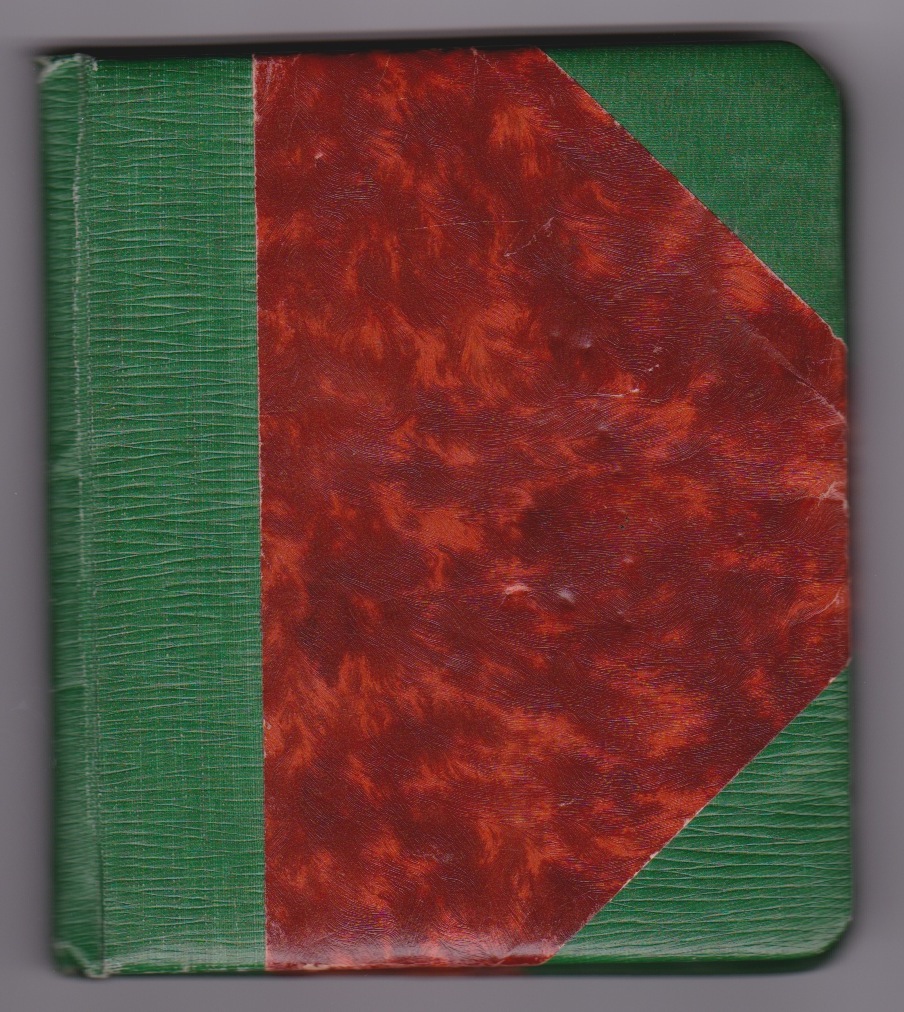
Diary 1935-36 closed book

Gerhard and Else at the Beach, July 1935

Gerhard and Else Rowing in July, 1935


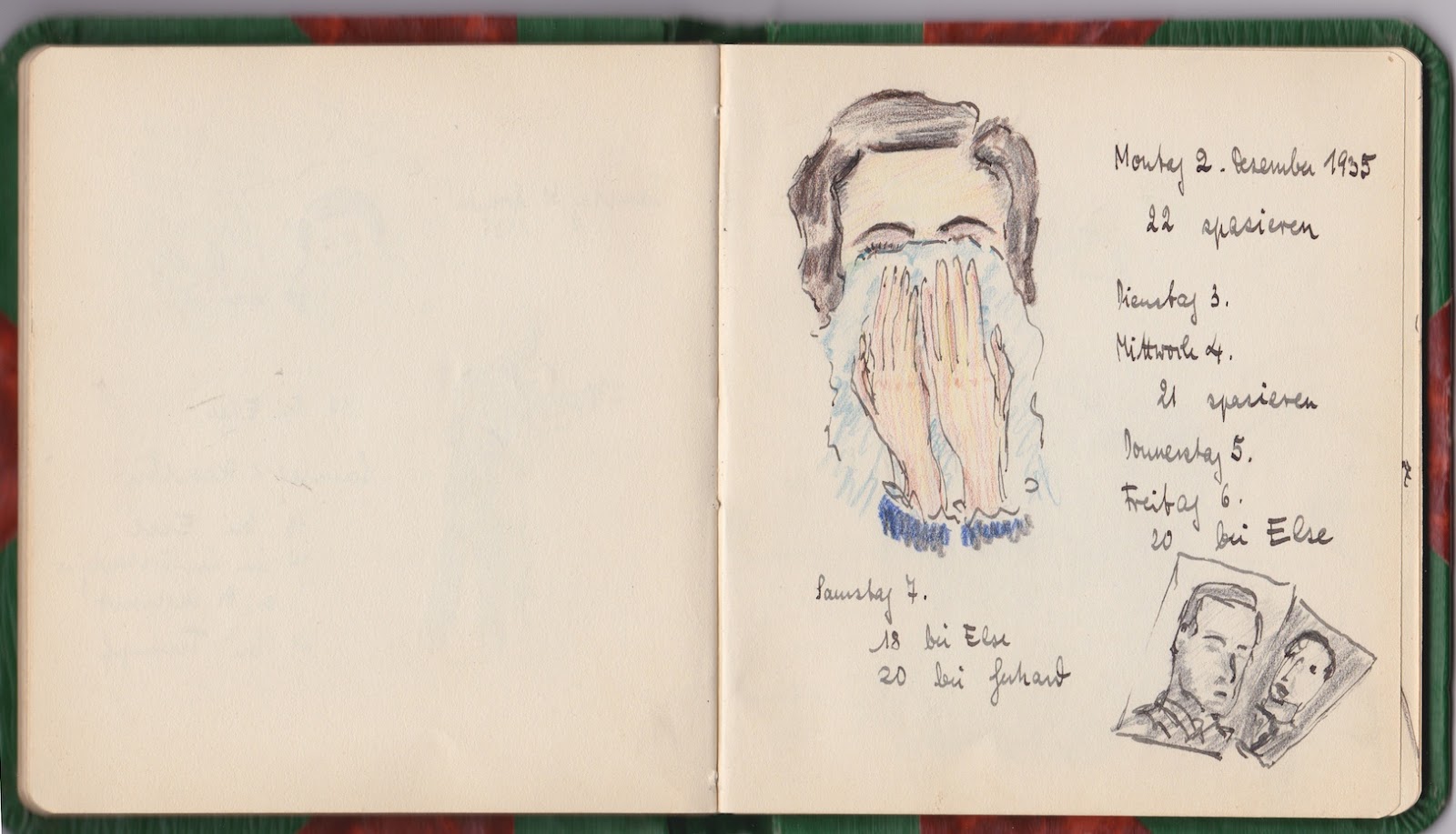
Today I found a beautiful diary of delicate sketches from 1934-36, in which my father Gerhard Graupe chronicles his day-to-day moments with my mother Else while they were still living respectively in Berlin and Rheda (small town in Westphalia), under the Third Reich,  just before my father fled Nazi Germany on a ship to Rio De Janeiro in 1936 in an attempt to get affidavits and visas for himself, his parents and my mother to come to the USA.


Visits and seeing PYGMALION September and October 1935


At the movies seeing IT HAPPENED ONE NIGHT in October 1935


High Holy Days October 1935


Else weeping December 1935

Embrace - notice the ring! December 1935

Under a Light in January 1936 walking and seeing the movie David Copperfield


Preparing to say goodbye, January 10, 1936


Goodbye at train station - January 1936


He spent 2 years living illegally in Rio, engaged to my mother, an attachment that never faltered - until he finally succeeded in getting the papers in 1938. Tragically he was unable to save his parents who died in the Concentration Camps in Theresienstadt.

My parents got married in NYC in 1938.

I also include my own visual diary of my mother while sitting at her bedside in Calvary Hospice drawing her every day for a month. She died on January 7, 2007.


Drawings in Calvary Hospice, 2006/07


Saturday, July 2, 2016

ROBERT MAHONEY WRITER AND CRITIC ON DILLON AND DURER 7/216


It's kinda fun having friends in a big group show, you occasionally hear aboustirrings behind the scenes. Seems that in The Female Gaze: Women look aMen, Part 2, now up (but not Sats) at Cheim and Read, Grace Graupe·Pillard's Dillon (2016), in addition to Sarah Lucas's White Nob, is garnering lots of selfie love from visitors. Artforum has posted a short shout out to the show on its website, and Hannah Stamler surprised me by comparing the pic to another work, "Others catch them in private moments of sleep or self-love, both literal and figurative, as in Grace Graupe·Pillard's painting of a young artist mid iPhone selfie, hand curled in a manner that recalls Durer's Self·Portrait in Fur Coat, 1500". The fun thing here for me is that I saw that the tattoo on Dillon was Durer's Praying Hands, placed on a chest this is clearly a good luck charm. But I missed the other Durer connection. However, it makes some sense. He's making one of those strange gestures that we all know but can't define (I was intrigued the other night at Blue, a great sushi place in town, when the sushi chef served us himself, and made a proud papa gesturpointing on what was what, with his index and middle finger together, you ALknow that hipster gesture). Anyways. If Durer's Portrait in Fur Coat link has some traction, that gesture in that picture is not simply a blessing. It is a variation on a well known trope of Renaissance portraiture. It is called the pseudozygodactylous gesture. Pseudo because men of creativity and patrons and benefactors basically borrowed from the female portrait, mainly of the Virgin Mary, the breastfeeding expression gesture (see comments below). thzygodactylous gesture, to express their creativity and beneficence. Dillon's gesture has a soft gender-bending nature of that sort, but placed in front of the praying hands it is like it is also saying, the love is over there, in the selfie.Very intriguing selfie. By the way, no surprise to me, when Graupe·Pillard does portraits, most of time it is all about the hands.

Pictures: Dillon, Grace Graupe Pillard; Durer Praying Hand; Durer, Portrait witFur Coat (1500). El Greco El Caballaro portrait reps pesudozygdactylous gesture; Durer version; back to Dillon. Some connection here

Robert Mahoney July 2, 2016