Translate

Monday, June 6, 2016

PHILIP GUSTON 1957-1967 EXHIBITION AT HAUSER & WIRTH 6/6/16

Since the mid-1960's I have had a special place in my heart for Philip Guston, even though I had not yet, ever heard of him or seen his paintings. He was a juror who awarded me a drawing fellowship at The Art Student's League, a much needed financial and ego boost.
Shortly thereafter - in 1970 I was sitting in my studio in Albuquerque, NM and was startled to read one of the worst attacks on an artist that I had ever seen - a review of Philip Guston's new body of work in The NY Times by the art critic Hilton Kramer titled “A Mandarin Pretending to be a Stumblebum.” I was confused since I really liked what I saw in the new work - it had a power that was direct, with the simplicity of a cartoon catapulted into raw and fresh invention screaming injustice and personal pain.

The exhibition at Hauser & Wirth of Guston's early 1967-67 paintings brought me back in time. This exhibition focuses on the early artworks - the abstract gestural, piling up of paint, forms hovering in the center of the canvas - never going beyond the edges - gestures not allowed to breathe despite the frenetic brushwork, but rather caged in by the framing white of the canvas. They felt old and musty - I could almost smell the mildew. It might have been the lighting which was dimmed, but I believe it was the work itself - these early pieces seemed relegated to the dustbin of history brought out to give us historical context for the great works which were to come. As we moved into the other rooms, all chronological - we could sense the difference. Grays and pinks and black appear - still floating but a change was a coming.

And then in the last room, I saw the drawings lined up in a row as they were originally seen in Guston's studio - done after the "bad" review when he went off and did what he called "pure drawing." They were a revelation - the link between the what was, and what was to become - and they were terrific. I am a sucker for evidence of the "flesh" under the shell, and his awkward line allowed me entrance into his primordial self.


Saturday, June 4, 2016

CINDY SHERMAN EXHIBITION AT METRO PICTURES GALLERY, NYC 6/2/16


Regrettably I am confused and disappointed with Cindy Sherman's new large photographs at Metro Pictures Gallery. I realize that these photographs deal with artifice and the way "women of a certain age" were portrayed by Hollywood in the 1920's - ie: Gloria Swanson - the eyebrows penciled on - thin and hard etched into one's forehead with the precision of a knife and thereby erasing their humanity. Is Sherman indicting the power of the Motion Pictures Industry to set standards and tastes of that era and relegating the older woman to an object of derision? Or is she perpetuating those earlier myths?
Focusing on the theatricality of this particular "look" and ignoring Hollywood's other cliched portrayal of older women as homemakers, nurturers and loving grandmothers Sherman chooses to portray "glamorous" older women with a feline appearance - one that depicts aging as a process that invokes ridicule. The backgrounds that are intentionally photoshopped behind the figures are selected from movies and help to accentuate the contrivance.


These are powerful images, but they are also a one-note broad brush portrait of a generation. Each character is Cindy Sherman made up by professionals with different wigs and prosthetics, her altered appearances lit by expertsfrom the Industry - yet there was a sameness to every piece that I attributed to simplistic alterations to the make up - the sensuality of the mouth reduced to changing the curves of the upper lip, morphing from heart shape to pointy triangles; the eyebrows thin - some shorter some lengthened to accentuate eyes that felt vacant and brittle.
There is a poignancy to these images but it demands a commitment to digging behind the curtain of artfulness.

Friday, June 3, 2016

JORDAN WOLFSON AND ANISH KAPOOR - CHELSEA GALLERIES, NYC 6/2/16


A short video snippet of a very disturbing exhibition by artist Jordan Wolfson at David Zwirner Gallery which ends June 25th. This exhibition focuses on a robot/puppet who is literally tossed and thrown around the room (as you see from the video.) What we are viewing is both aggressively frightening and incredibly sad. Pulled NOT by strings but by chains - alluding to historical repression and personal constraints. Crashing sounds are loud and abrasive. The occasional moments of silence pierce your being with its stillness - the puppet's eyes darting around reflecting eternal anguish.

https://www.youtube.com/watch?v=HTvRfXAU5es&feature=share

PLEASE make this full screen to get a strong impact of the show. (click on square box - right hand side below video - and press ESC on keyboard to return to regular size.)


Anish Kapoor's exhibition at Barbara Gladstone Gallery on 24th Street is an almost 360 degree rotation from his earlier works. I first encountered his fragile, seductively gorgeous powdered pigment pieces in the 1980's spilled out on the floor; works so delicate that the slightest sigh of appreciation expelled from one's breath could scatter the particles into the air. Those artworks were not commercially viable, and Kapoor has spent the last 30 years working with granite, limestone, and marble, often creating biomorphic forms, using the light on reflective surfaces to explore what appears as a "void", but is actually an illusionistic tryst with nothingness.
"Internal Object In Three Parts" 2013-2015 refers to the Greek legend of the satyr Marsyas who challenged Apollo to a musical duel whcih Marsyas lost; upon defeat Apollo tied Marsayas to a tree and skinned him alive. These pieces are also about surfaces - but these surfaces evoke raw chunks of red and white gristled meat reminding me of Soutine's modest-sized paintings wrought large, coming off the canvas to attack you. Kapoor's artworks consist of three-panel reliefs in painted silicone and wax - depicting bloody drippings that have been chewed off ravaged animals, an open wound left to rot. The world is a violent mess and Kapoor is exposing its savagery.


Sunday, May 8, 2016

HOCKNEY 5/7/16


I recommend the documentary film HOCKNEY, where we get to "know" David Hockney through the lens of old movies, interviews with family members and close friends, and most importantly his art. The focus of the film is footage of Hockney talking about his paintings, his personal life, his first serious relationship with a beautiful young man named Peter, and his long, deep affection for Henry Geldzahler.

We get a feel for his sense of place by viewing his childhood home in Bradford England; an eventual move to NYC while he was in his twenties; a trip to Hollywood, the setting of most of the "pictures" he had seen as a child in the local movie theater, and his instant attraction to the California way of life with its palm trees and swimming pools, eventually shuttling between England and USA. setting up studios/homes in both locales.

As a young art student he was already daring - had the right sense of style with those big round glasses framing his then jet black-hair. He ultimately changed his look and became a blonde, after viewing Clairol commercials on TV. Loved seeing the drawings and paintings that were so familiar to me, particularly the ones of his parents - works that I have always cherished - blown up large on the big screen enveloping the audience. We see how Hockney's work matures over time, his desire to paint in whatever style or subject matter he felt attracted to (damn the prevailing ethos,) and how photography influenced his idea of rejecting the concept of perspective's vanishing point - and turning it inside out - rather the viewer being the "vanishing point" of a painting.

I have a theory that the greatest artists' works are their late works, ie: Goya, Manet, Monet, Rembrandt, Titian, Morisot, Mitchell, etc. I saw David Hockney's last two shows in NYC and they were by far the best paintings that he had ever done - (an exception being the iPad drawings- they felt too constrained by the medium.) In HOCKNEY, he visits the Grand Canyon and we see how he creates masterful works that belie the fact that age does not have to be about diminished capacities - at 78 years old, his paintings fill the room with color, light and the presence of a man whose curiosity and vitality are in abundance.

Sunday, February 14, 2016

ROOM 2/14/16


Kidnapped at fourteen and locked up in a room for seven years with a five year old child conceived through violence, director Lenny Abrahamson’s film inspired by Emma Donoghue’s novel of the same name - a composite of true events - is titled ROOM; a delicate and harrowing story of two people caught in a private space, where they live a life of extreme tenderness and tension.  The actors are excellent, Brie Larson as Ma and Jacob Tremblay as Jack create a home/neighborhood/community/country  inside a small, cluttered “room” with occasional shafts of light beaming down from a skylight that displays the stars and moving clouds - the outside “world” a dream beyond their reach.

 A television sputtering on the blink allows that other “world” entry, but for young Jack, what he sees flickering on the screen is both real and “make believe” ; distinctions have been erased and are unknowable. The relationship between mother and child is stunning - the  connection between them is acutely poignant, as if the umbilical cord had never been severed. Days are spent exercising, running back and forth- sharp turns are necessary after a few steps, making us aware of the claustrophobic feel of the space; and Ma’s attempt to teach her son to read and maintain a somewhat “normal” existence is impressive and heart-rending. Jack’s poetic and descriptive use of words to describe his circumscribed environment invokes the originality and charm of expressing and interpreting  what we see and feel through language tailored to one’s unique cosmos. We also witness the chilling visits of “Old Nick” her captor whose step on the stairs on his way to the “room” is a sign for little Jack to hide and feign sleep behind a shuttered closet door - the presence of “evil” glimpsed through cracks in the battered and weatherworn slats.

When Jack turns five his mother decides he is old enough to participate in an escape plan involving resilience and courage which eventually succeeds. Mother and child are hospitalized and the second half of ROOM begins. How to acclimate one’s self to being separate individuals, after the powerful link between them is sundered - a tie which was both nourishing and restrictive? Accommodation to “freedom” begins, and the aching awareness of the familiar becoming unfamiliar, as well as the unfamiliar becoming familiar, are daunting and formidable.


ROOM is an exquisitely fragile story of the pliancy of the human resolve to survive and adapt to suffocating circumstances and adjust to the shock of change after flight and rescue. A child’s ability to embrace the magic of his new environs - as one Dr. mentioned in examining Jack, “he is still plastic”; and an adult’s more complex road to acclimatization which includes grieving the loss of a singular bond where the “other” completes you to the exclusion of everyone else.

Monday, February 8, 2016

FIRST LOVE - AN INTENSE AND TENDER RELATIONSHIP - 2/8/16

My article on "first love" was published in Women's Voices For Change.


“A relationship of intense beauty and emotional anarchy was formed, waged by teenagers in the vortex of ‘romantic love,’ where infatuation, anger, and jealousy crack through the shell of invincibility and time is forever-after.”

— Grace Graupe-Pillard


I was fourteen years old – a young, slender girl with a short pixie haircut who congregated after school with a group of friends in Washington Heights, New York City, at "the steps"– steep gray concrete steps linking two neighborhoods: the lush green, tree blooming, up-on-the-hill Pinehurst Avenue and the dry, commercial-store-lined 181st street down below. That's where my sister and I lived in an apartment with our immigrant parents and grandmother. a view of the George Washington Bridge and the slowly moving Hudson river in our backyard. Nestled at each stair landing were enclaves of benches for those who needed a breather as they made the long and arduous trek to the top. But for a  high-spirited young lady with all of life’s possibilities looming before her, bounding up and down the stone stairway was a breeze. I was the fastest runner in my Public School, even beating out the boys, though for the past two years I could feel my interest in the opposite sex changing. 


Richie, a very tall, handsome, sandy-haired young man with the clearest brown eyes, two years older than I was, would occasionally hang out with us, and I felt this incredible urge to win his attention – a desire to bump into him to get him to notice me. I had an innate sense of the power of my own budding sexuality and a teenager’s trust in surrendering to what was dark and mysterious–not worrying about consequences–coupled with a belief in the incorruptibly of innocence. I had heard rumors that Richie was a bad boy, smoking, playing hooky,  and getting into all kinds of trouble in High School, but I knew that whatever he had experienced before meeting me would change. And I was right.


One night at a party, Richie having drunk too much, became sick and, retching over the toilet bowl, he admitted to feeling a mutual attraction. I, who don’t drink at all, clearly understood the import of his response. A bond was sealed that was to last for two years. A relationship of intense beauty and emotional anarchy was formed, waged by teenagers in the vortex of “romantic love,” where infatuation, anger, and jealousy crack through the shell of invincibility, and time is forever-after. We were inseparable–a couple of kids who believed that we could build a cocoon around our lives that could last for an eternity. 


I would accompany Richie on his after-school job delivering clothes for a dry cleaner's, walking up and down local city blocks, waiting on street corners in the heat and cold while he delivered the neatly pressed clothes on hangers wrapped in plastic. While we walked we talked about everyday, mundane activities. We attended different High Schools: I went to one that specialized in art and music, and he went to one locally–a star of the swimming team. Primarily we were interested in the pleasure of being close to each other. The hypnotic, captivating excitement of upcoming sensual contact hovered over all our activities–particularly on those afternoons when no one was home and I would go to his apartment, where we probed the topography of unknown and unexplored bodily terrains.

First love is the most magical, deliciously exquisite, and seductive period of one’s life when the world actually becomes luminous without the need of the sun or the moon. Richie was never a “bad” boy and I was not the “bad seed” that my mother once called me. Together we felt secure and protected, buoyed by our ability to connect and blot out everything and everyone else.

Because of the fervor of our intimacy which was considered to be unhealthy, our worried families eventually decided that it was important that we be separated, and Richie was sent to school in Tucson, Arizona, a world away from NewYork City. Ultimately, passions drain, other distractions, and people come into our lives, and communication fades. Years later, once I got a computer, we were back in touch. He now had a wife and children and I a husband. We saw each other again when I was visiting a very close friend in California who was ill with AIDS, and we sat on a rock, meeting on the opposite Coast from where we began our friendship and talked and talked, the sensitivity of his presence still giving me solace.

 Richie died unexpectedly, a few years later from a heart attack, but the memory and poetry of our dramatic youthful liaison are permanently inscribed in my heart, which has never capitulated to anyone else with the same abandon.

Friday, February 5, 2016

TWO EXHIBITIONS - GREGORY CREWDSON AND GUIDO van der WERVE IN CHELSEA, NYC 2/5/16


Gregory Crewdson's moving and amazing exhibition titled CATHEDRAL OF THE PINES- photographs of landscapes that have the texture, light and resonance of masterful painting with figures that often feel like they were painted by Georges De La Tour or sculpted by Duane Hanson dislocated from their environment, but still vital to the narrative. I leave Crewsdon's exhibitions with an aching sadness.


http://www.gagosian.com/exhibitions/gregory-crewdson--january-28-2016


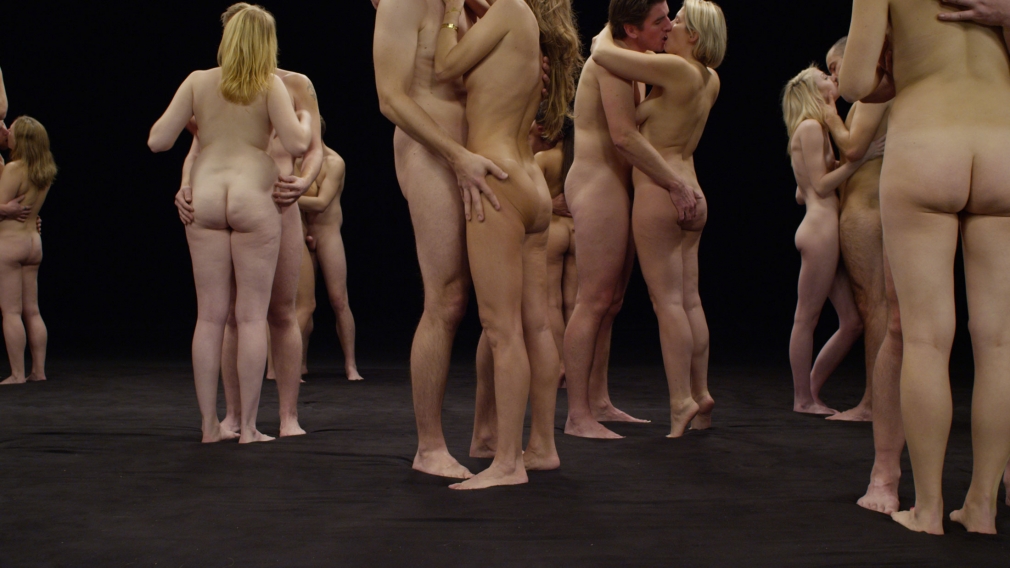
We enter a darkened room and a see a 3-Channel screen with naked elderly men and women; some seated, some standing, and others moving slowly like turtles on the left screen - their presence invisible to most viewers; the center screen has clothed middle-age people practicing Yoga and other psychological/spiritual practices; and on the right screen where most of the audience is focusing their attention, are a group of nordic-looking, beautiful young people exuding the energy of eros. All of the participants seem to be strangers who are connecting randomly.

The Dutch artist Guido van der Werve's videos are shocking in their blatant depiction of the sexual act from pre-coital touching to the exhaustion of spent copulation. What begins with a programmed gentle touch becomes a slapping mechanical fornication - which goes on and on and is exhausting to witness. Literally stripped of any eroticism - the mechanics of sex becomes laborious and tiresome.
Meanwhile on the left screen the older folk lay about eating and slowly moving from place to place without vitality. At the very end of the film, everyone ends up in similar positions - splayed out on the floor, bodies fallen in utter capitulation to whatever life force has been exerted. According to the Press Release the videos projected on the three walls represent the id/ego/superego lasting about 40 minutes and beginning every hour - played out in 12 acts (the months of the year.) The names of the astrological signs beginning each new chapter with a visual depiction of the constellations. The only sounds, we hear besides the slurping of sex is a lonely player piano in the center of the gallery - a proxy for the artist himself who has "written a score in 12 parts in the 12 major keys" - the tones clear and lucid.
I was both fascinated and bored - despite its rigid structural formality, the images reflected the simplistic categorization of passion/libido with the passing of time. Desire is not wiped out with age - it is enriched by tenderness and experience.
http://www.luhringaugustine.com/exhibitions/guido-van-der-werve4#14
http://www.luhringaugustine.com/exhibitions/guido-van-der-werve4/press-release